Why Are So Many Republicans Raising Teacher Salaries?
From Florida to Iowa, post-COVID budget surpluses and post-Trump populism fuel push to neutralize Democrats
By Kevin Mahnken | September 21, 2022In late March, Florida Gov. Ron DeSantis made a major announcement on K-12 education.
It didn鈥檛 concern the so-called 鈥淒on鈥檛 Say Gay bill,鈥� which had triggered nationwide controversy earlier that month over its restrictions on classroom instruction about gender and sexuality. And no mention was made of critical race theory, a frequent target of conservative ire. Instead, the outspoken Republican took the opportunity to confirm that his upcoming state budget would include $800 million to raise salaries for both novice and veteran teachers, a massive increase over the previous year.
鈥淥ver the last three years, we have worked hard to increase teacher pay. We have invested more than $2 billion in teacher pay, and with rising inflation, this could not come at a better time,鈥� . 鈥淭his will help Florida to recruit and retain great teachers.鈥�
The proposal, which took effect July 1, seemed like a glitch in the political matrix of 2022. DeSantis 鈥� a red-state exemplar many believe will challenge Donald Trump for the Republican presidential nomination 鈥� has eagerly charged into countless education fights over the past few years, from COVID safety to trans athletes in girls鈥� sports. Given his for 鈥渨oke indoctrination鈥� in classrooms, many teachers have felt particularly under siege.
But he was also only one of several Republican politicians this year to either propose or enact record teacher pay raises. In Georgia, Iowa, Oklahoma, Alabama, and Mississippi, governors are both fulminating against critical race theory and offering sizable new incentives to attract educators in a tight labor market. The explanation is partly economical: Following the injection of billions of dollars in federal pandemic relief, states are free to make financial commitments that would have seemed impossible only a few years earlier.

But the combination of social conservatism with fiscal expansiveness may also be an artifact of the post-Trump GOP, said Rick Hess, director of Education Policy Studies at the conservative American Enterprise Institute. A party that has largely discarded its 鈥済reen eyeshade role鈥� is now free to adopt a potent electoral posture, he argued.

鈥淭he fact that Republican governors are generally aligned with two-thirds or more of the public against progressive dogma regarding race and gender gives more populist Republicans a potential twofer,鈥� Hess said. 鈥淸The party] gets to support teachers while criticizing ideological extremism in school policies, teacher training, and such.鈥�
Bradley Mariano, a professor of education policy at the University of Nevada, Las Vegas, added that the bipartisan enthusiasm for boosting teacher pay could actually give Republicans a freer hand to pursue more disputed policies, such as expanding school choice or more tightly regulating speech in classrooms.
鈥淭hey have gained some political capital from providing teachers these historic raises, so it gives them a little cover to go after other items [of their agenda],鈥� Marianno said. 鈥淎nd if they receive pushback, they say, ‘Hey, I just raised salaries to historic levels!'”
Push from voters
The politics behind the trend are unambiguous, if somewhat clashing: For the moment, large segments of the public in classrooms. Even more than that, however, they want to see teachers make more money.
The first point was made clear by a poll released in July. Not only did nearly 1,800 respondents in swing states say they trusted Republicans over Democrats on the issue of education; by huge margins, they also said they favored banning instruction of sexuality and gender identity through the third grade and prohibiting trans students from competing in girls鈥� athletics competitions 鈥� essentially the DeSantis education platform. Most striking of all was the fact that the research was commissioned not by a conservative source, but by the American Federation for Teachers, the nation鈥檚 second largest teachers鈥� union.
A newer poll indicates that the public is even more supportive of higher teacher pay. According to the recently released Survey of Public Opinion on Education Policy, published annually by the journal Education Next, openness to educator raises has risen to a record high (from 61 percent in 2017 to 72 percent in 2022). After the upheaval and adversity inflicted by COVID, it is clear, the American public believes that teachers deserve somewhat larger paychecks.

Beth Lewis is the executive director of Save Our Schools Arizona, a progressive activist group that advocates for higher school spending and against the expansive school choice agenda of the local Republican Party. In an interview, she dismissed Republican commitments to salary increases as 鈥渓ip service鈥� made necessary by political necessity.
鈥淭hey’re seeing the same polling I’m seeing 鈥� voters overwhelmingly want to support teachers and want higher teacher pay 鈥� so in order to get reelected, they need to say that they’re in favor of raising teacher pay,鈥� she said.
Lewis co-founded SOS Arizona in 2018, a year when teachers in multiple states walked out of the classroom in protest of years of stagnant pay and school spending. The months-long 鈥淩ed for Ed鈥� campaign, punctuated by dramatic marches on state capitols by thousands of red-shirted teachers, was credited with fueling the Democrats鈥� success in midterm elections that fall and helping reverse a prolonged dip in school spending following the Great Recession.
In Arizona, irate educators from Republican Gov. Doug Ducey. But the movement鈥檚 real victory came in changing the public conversation around teacher compensation. Ducey is term-limited from seeking re-election this year, but the Republican nominated to replace him is Kari Lake, a Trump-endorsed conservative who has proposed in classrooms to thwart subversive instruction. Even so, to offer 鈥渕ore money (and a better work environment) for teachers,鈥� arguing that previous salary increases were squandered or misappropriated by local school districts. In recent weeks, that she might support to grant a permanent $10,000 raise to all Arizona teachers.

Akilah Alleyne, director of K-12 education policy at the liberal Center for American Progress, said she welcomed calls for higher education spending, but noted that to provide teachers with a 鈥渓ivable wage鈥� had found no GOP co-sponsors.

鈥淭eachers absolutely deserve better pay, and it鈥檚 great to see more people speaking up about taking action at the structural level to support this fight,鈥� Alleyne wrote in an email. 鈥淏ut it鈥檚 hard not to鈥erceive Republicans鈥� sudden flood of teacher-pay talking points as a manipulative, back-to-school political ploy to win votes.鈥�
The salary hikes were defended on both political and substantive grounds by Michael Petrilli, president of the reform-oriented Thomas B. Fordham Institute. All governors like to 鈥減lay Santa Claus鈥� in times of fiscal plenty, Petrilli noted, and few would quibble with this round of generosity given 2022鈥檚 rapidly rising prices.
鈥淚 can’t muster much of an argument against it at a time when we’ve had 9 percent inflation and teacher salaries struggle to keep up with the cost of living,鈥� Petrilli said. 鈥淚f you’re a governor 鈥� and especially if you’re up for reelection in November 鈥� and you’ve got the money, this is a no-brainer.鈥�
鈥楾he money eventually runs out鈥�
Governors, whether Republican or Democratic, seem to feel more free to act on education policy than in previous periods. Marguerite Roza, an education finance researcher and director of Georgetown University鈥檚 , said that the mass teacher organizing of 2018 may have permanently shifted bargaining efforts from the local to the state level.

鈥淭he Red for Ed movement was curious in that, instead of striking or blaming their local districts, they put their shirts on, marched to the statehouse鈥nd pressured their governors and legislatures for raises. Maybe that’s sort of the new relationship there: The governor of the state is supposed to do something about teacher pay.鈥�
And after more than two years of crisis management, state leaders have unparalleled resources to carry out their campaign promises. With nearly directed explicitly toward state education budgets, most of which remains unspent, the funding exists to offer teachers a boost.
The temptation to raise pay, whether through one-time signing or retention bonuses or in permanent changes to starting salaries, is especially acute at a time when private-sector jobs are plentiful and districts are struggling to fill vacancies. Although teachers are generally considered more likely to jump ship between districts than cross state lines, the frenzied search for staff could lead states to attempt to outbid one another for scarce human capital.
But as abundant as federal funding has been, it is earmarked only through 2024. At that time, many of the Republicans who have green-lighted raises since the pandemic鈥檚 onset may need to reverse the salary movement 鈥� or even cut jobs entirely.
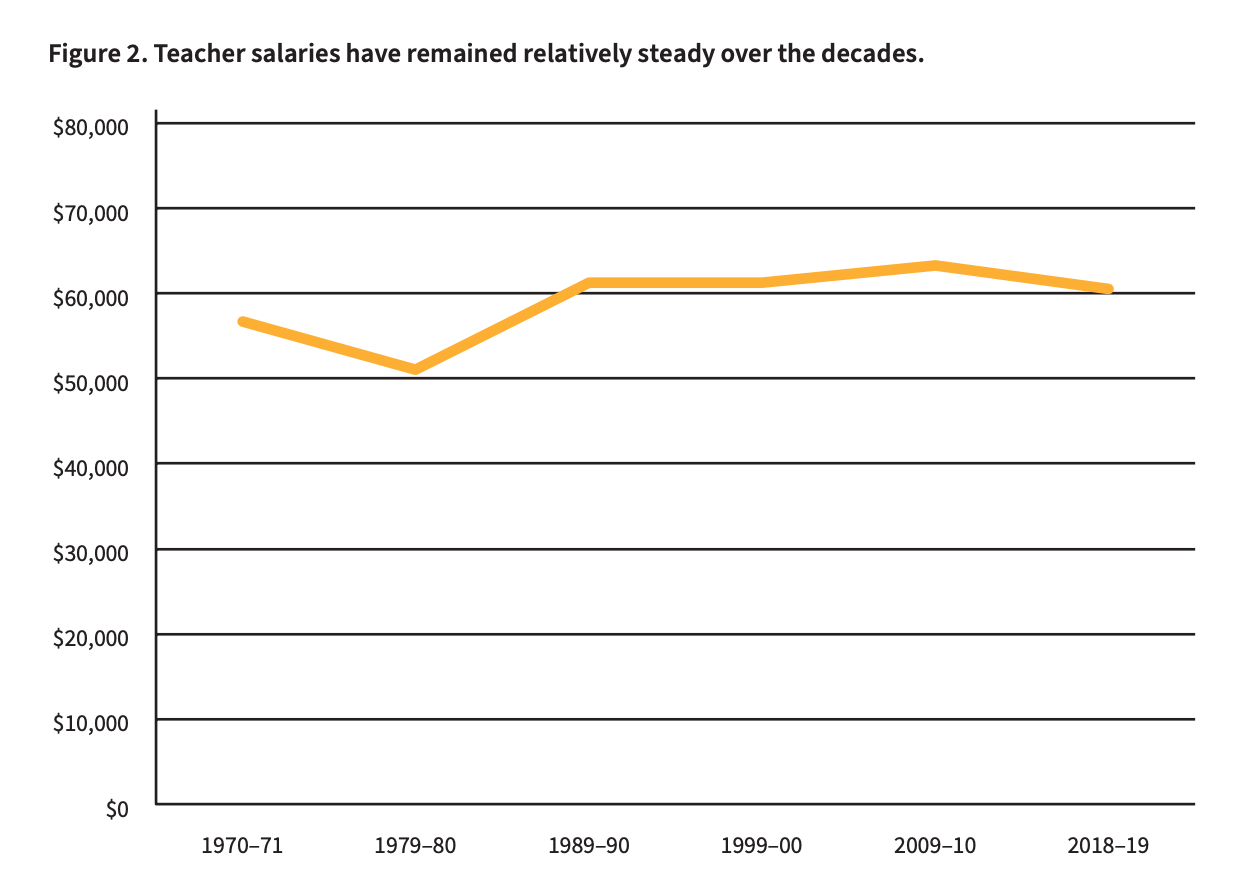
Roza argued that the main reason teacher salaries have remained flat for so long is that over improving pay for existing staff. That tendency has continued during the COVID era, contributing to the hiring scramble of the past few years. If states are to reach a long-term accommodation with teachers that results in higher pay or benefits, she said, one consequence might be an unwinding of those long-term trends.

“Over the last 50 years, school districts have added a lot of staff and not really done much for pay,鈥� she said. 鈥淪o if states get themselves in a pickle where they can’t afford these pay raises, what we might expect as a tradeoff would be fewer FTEs [full-time equivalents] and a reversal of that trend.”
UNLV鈥檚 Marianno partly agreed, arguing that the spike in pay across some states will trigger an inevitable reaction in job interest.
鈥淚 do think the raises will help attract more teachers into the profession until you see a correction there, and as the demand for teachers decreases, the price that school districts are willing to pay will also decrease. As often happens with school finance, the money eventually runs out.鈥�
Did you use this article in your work?
We鈥檇 love to hear how 蜜桃影视鈥檚 reporting is helping educators, researchers, and policymakers.
